Key Takeaways
- Extendable dining tables provide flexible seating capacity without permanently occupying floor space — a 160cm table that extends to 260cm seats 4-6 people daily and 8-10 for gatherings
- Extension mechanisms vary in durability — folding leaf systems with quality hardware outlast cheaper slide-out designs by 10+ years
- Each person needs approximately 60cm of table width for comfortable dining — use this to calculate your required extended length
- European manufacturers like Angel Cerda use 0.5mm thick walnut veneer and reinforced extension hardware that maintains alignment after thousands of uses
- Measure your dining room clearance before purchasing — you need 90-100cm around the extended table for comfortable chair movement
What Is an Extendable Dining Table?
An extendable dining table is a dining table with a built-in mechanism that allows the surface to increase in length, typically by 40-100cm, to accommodate additional seating when needed.
The design solves a practical problem: most households need a compact table for daily meals but occasionally require space for guests. Rather than dedicating permanent floor space to a large table used only a few times per year, an extendable table provides both configurations in one piece of furniture.
Why Extension Mechanism Quality Matters
The mechanism determines whether your table functions smoothly for decades or becomes frustrating within years.
Folding Leaf Systems: The extension leaf folds and stores within the table body. When extended, you pull the table ends apart, unfold the leaf, and push the ends back together. Quality versions use metal guide rails and locking mechanisms that maintain perfect alignment.
Butterfly Leaf Systems: Similar to folding leaf, but the leaf folds in half and rises automatically from beneath the table surface. This eliminates the need to unfold manually but requires more complex hardware.
Removable Leaf Systems: The extension pieces store separately from the table. This allows for more leaves (and greater extension) but requires storage space and handling each time you extend.
What separates quality mechanisms from budget versions:
- Metal guide rails vs. plastic tracks — metal maintains alignment over thousands of extensions
- Locking mechanisms that secure the extended position — prevents wobble during meals
- Reinforced connection points — distributes stress across the frame rather than concentrating it
- Smooth operation — quality tables extend with gentle pressure, not wrestling
Calculating Your Required Table Size
Before choosing a table, determine your seating needs for both daily use and maximum capacity.
The 60cm rule: Each seated person needs approximately 60cm of table edge for comfortable dining with elbows at rest. Formal settings with multiple courses may benefit from 70cm per person.
Example calculation:
- Daily household of 4 people: 4 × 60cm = 240cm total perimeter needed
- A 160cm × 100cm table provides 520cm of perimeter — adequate for 4-6 people
- Occasional gatherings of 8 people: 8 × 60cm = 480cm perimeter needed
- Extended to 260cm × 100cm provides 720cm of perimeter — comfortable for 8-10 people
Room clearance requirements:
- Minimum: 75cm from table edge to wall (allows seated diners but tight movement)
- Comfortable: 90-100cm from table edge to wall (allows chairs to pull out fully and people to pass behind)
- Generous: 120cm+ (accommodates wheelchair access and serving)
Measure your dining room with the table at maximum extension before purchasing.
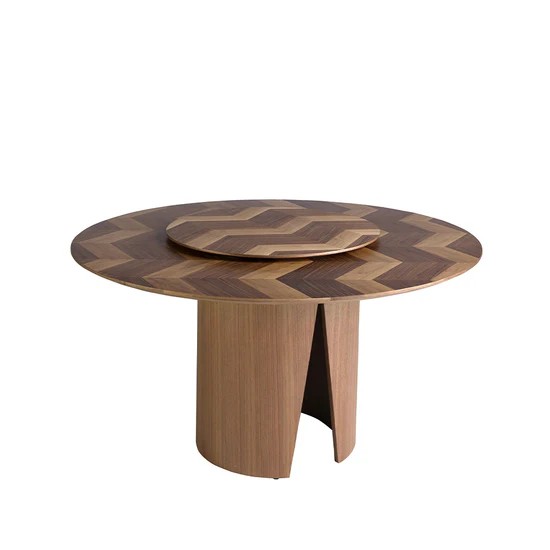
Featured Product: Angel Cerda Model 1012
The Angel Cerda Model 1012 demonstrates European engineering applied to extendable table design:
- Top Material: Natural walnut veneer, 0.5mm thickness
- Closed Dimensions: 160 × 100 × 76cm
- Extended Dimensions: 260 × 100 × 76cm (with both leaves)
- Extension System: Two 50cm folding leaves stored within table body
- Seating Capacity: 4-6 closed, 8-10 extended
- Construction: Solid wood frame with walnut veneer surfaces
- Certification: ISO 9001 quality management certified manufacturer
The 0.5mm veneer thickness matters because thinner veneers (0.2-0.3mm common in budget furniture) show wear patterns quickly and cannot be refinished. The solid wood frame ensures the extension mechanism maintains alignment over years of use.
Choosing the Right Shape
Rectangular: Maximum seating efficiency. Both ends accommodate diners, and extension adds length without changing the basic proportions. Best for dedicated dining rooms.
Oval: Softer visual appearance with no sharp corners. Extension typically adds length while maintaining the curved ends. Good for rooms that serve multiple purposes.
Round-to-Oval: Compact when closed, extends to oval for gatherings. Excellent for smaller spaces where a round table works daily but more capacity is occasionally needed.
The Angel Cerda Model 1133 exemplifies the oval approach — porcelain marble top with walnut barrel base, extending from 180cm to 220cm while maintaining elegant proportions.
Material Considerations for Longevity
Solid Wood: Most durable option. Can be refinished multiple times over decades. Heavier, which actually benefits stability. Walnut and oak are traditional choices for quality tables.
Wood Veneer over Engineered Core: Provides the appearance of solid wood at lower weight. Quality veneers (0.5mm+) on stable cores perform excellently. Budget veneers over particleboard degrade quickly.
Tempered Glass: Modern appearance, easy cleaning. The Angel Cerda Model 1123 uses 10mm tempered glass with walnut veneer legs, extending from 160cm to 240cm. Glass thickness matters — 10mm provides durability, while 6mm feels fragile.
Porcelain Marble: Combines marble appearance with superior durability. Resistant to scratches, heat, and staining that affect natural marble. Increasingly popular for contemporary dining rooms.
Coordinating Chairs with Extendable Tables
Since your seating needs vary, plan your chair strategy:
Core chairs (daily use): Purchase quality chairs equal to your closed table capacity. These receive the most use and justify higher investment.
Extension chairs: For occasional use, matching chairs stored elsewhere or stackable designs work well. Some households use a bench on one side when extended, reducing the total chair count needed.
Clearance check: Ensure chairs fit under the table when pushed in. Arm heights must clear the table apron. Seat widths must not exceed the per-person table allocation.
Common Mistakes to Avoid
Ignoring extended clearance: A table that fits your room when closed may block doorways or traffic paths when extended. Always check extended dimensions against your floor plan.
Prioritizing looks over mechanism quality: The extension system is the most stressed component. Beautiful tables with cheap mechanisms become frustrating quickly.
Forgetting storage for removable leaves: If your chosen design has separate leaves, plan where they will live when not in use. Leaves stored improperly can warp.
Underestimating weight: Quality extendable tables are heavy — often 50-100kg. Ensure your floor can support the weight and that you can move the table if needed.
About This Guide
This guide was written by the Dellino Exclusive design team, specialists in European furniture with direct manufacturer relationships including Angel Cerda (Spain), DOCA (Spain), and Naxani (Spain).
Since 2018, Dellino Exclusive has furnished dining rooms across Africa, Europe, and the United States. Product specifications are verified directly with manufacturers. This guide is reviewed quarterly.
Dellino Exclusive carries the complete Angel Cerda dining table collection, including extendable models in walnut, glass, and porcelain marble. All products meet ISO 9001 quality standards with full manufacturer warranties.
Explore the Dining Tables Collection → https://dellinoexclusive.com/collections/dining-tables
Browse the Extendable Tables Collection → https://dellinoexclusive.com/collections/extendable-tables
Frequently Asked Questions
How much does an extendable dining table typically extend?
Most extendable tables add 40-100cm to their closed length. Angel Cerda tables typically extend by 50-100cm using folding leaf systems. For example, the Model 1012 extends from 160cm to 260cm — adding 100cm total through two 50cm leaves. This transforms a 4-6 person table into seating for 8-10.
How do I know what size extendable table I need?
Calculate 60cm of table edge per seated person. For a household of 4 with occasional gatherings of 8, you need a table that provides approximately 240cm perimeter closed (comfortable for 4) and 480cm+ extended (comfortable for 8). A 160cm × 100cm table extending to 260cm × 100cm satisfies both requirements.
What is the most durable extension mechanism?
Folding leaf systems with metal guide rails and locking mechanisms provide the best long-term durability. Avoid plastic tracks and friction-fit designs. European manufacturers like Angel Cerda use reinforced hardware designed to maintain alignment through thousands of extension cycles over decades of use.
Can extendable tables be as sturdy as fixed tables?
Quality extendable tables with proper engineering are functionally as sturdy as fixed tables. The key factors are frame construction (solid wood vs. particleboard), mechanism hardware (metal vs. plastic), and locking systems (secure vs. friction-only). Budget extendable tables often wobble when extended; premium tables do not.
How do I maintain an extendable dining table?
Clean surfaces with a soft damp cloth and mild soap. For wood veneer, apply furniture polish every few months. Periodically check that extension mechanisms operate smoothly — a drop of furniture wax on guide rails prevents binding. Store removable leaves flat to prevent warping. Avoid placing heavy objects on extension joints.
Featured Image Source: https://dellinoexclusive.com/products/dining-table-angel-cerda
