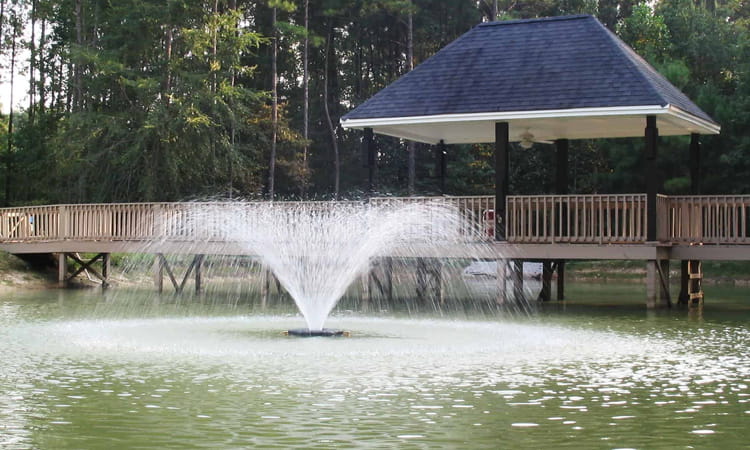
Sizing a fountain pump is not guesswork. A pump that’s too weak leaves your water feature looking tired, barely moving. One that’s oversized pushes too hard, wastes power, and can stress the whole system. There’s a middle ground, and finding it comes down to three things: how much water your pond holds, how high the water needs to travel, and how fast you much volume you want to move.
The Numbers That Run Every Fountain
Matching Output to Your Setup: A submersible water pump for fountain use needs to move water at a rate that matches your feature’s height and spread. The general rule is that for small ponds, like koi ponds, your pump should circulate the full pond volume once every one to two hours. A 500-gallon pond needs a pump rated for at least 500 GPH at the required head height. Not at zero head. At actual working height. For large ponds that stock bass, carp, catfish, and other kinds of fish you, of course, cannot be expected to circulate your entire pond’s volume every hour or even every day. But your pond does need aeration, and how much aeration your pump provides depends on the net flow of water going into the air from the nozzle. It is not horsepower that matters so much; it is total water circulation. The water needs to leave the pond and combine with air so that water dropping back down is oxygenated.
Spray Pattern and Pond Volume: Pond fountains come in a range of sizes, and the spray pattern your feature can realistically support depends on how much water you’re working with. Wider ponds need pumps that push water higher and outward. A tight vertical jet on a large, shallow pond just looks wrong and under-aerates the water. Match the spray radius to roughly half the pond’s diameter for balanced coverage and proper water movement.
When Aesthetics Meet Engineering
Head Height Changes Everything: Head height is the vertical distance water must travel from the pump to nozzle. Every foot of lift reduces a pump’s effective flow rate. A pump rated at 800 GPH at zero feet might only push 500 GPH at four feet. Factor that in before purchasing. Ignoring it is one of the most common and expensive sizing mistakes people make.
Hydraulic Flow Basics: Hydraulic flow rate is the actual volume of water the pump delivers under real working conditions. It accounts for friction loss in tubing, bends, filters, and vertical lift. Always size up slightly from your minimum calculation. Running a pump at its absolute upper limit shortens its life and creates problems that show up quietly, over months, before anything breaks visibly.
Sizing Reference: Common Pond and Pump Combinations
Here is a practical starting point based on typical residential setups:
- 100-300 gallon pond: 300-600 GPH pump, 1-2 ft head height suits tabletop or small garden features
- 300-600 gallon pond: 600-900 GPH pump, 2-4 ft head handles moderate garden fountains with standard spray
- 600-1,000 gallon pond: 900-1,500 GPH pump, 3-5 ft head supports mid-range floating or tiered designs
- 1,000-2,500 gallon pond: 1,500-3,000 GPH pump, 5-8 ft head works for large decorative or aerating fountains
- 2,500+ gallon pond: 3,000+ GPH pump, 8+ ft head is necessary for estate or commercial-grade features
These are starting points. Tubing diameter and filter resistance both pull numbers down in real conditions.
What Gets Ignored Until It’s Too Late
Tubing Diameter and Flow Loss: Flow restriction from narrow tubing quietly kills pump performance. A pump sized correctly on paper can underperform by 30 percent or more if connected to tubing that’s too narrow. Measure the pump’s outlet diameter and match tubing accordingly. Stepping down tubing size even once along the run creates back pressure that compounds.
Seasonal Load and Debris: Summer algae buildup and autumn leaf debris add strain to any pump. A pump sized to exact minimum requirements in spring will struggle by July. Build in a buffer. Slightly more capacity than you think you need is almost always the smarter choice for long-term reliability.
Your Pond Deserves Better Than a Best Guess
Sizing a fountain pump with real numbers takes maybe twenty minutes of math. Skipping it costs more in replacement parts, wasted electricity, and poor water quality than most people expect. Measure your pond. Calculate head height. Then choose a pump rated for your actual working conditions, not ideal ones. Start with the volume formula, check the sizing table, and pick a pump that has a little room to breathe. Your water feature will show the difference.
Featured Image Source: https://www.fountaintechpumps.com/wp-content/uploads/2022/12/Kasco-VFX-3400.jpg
